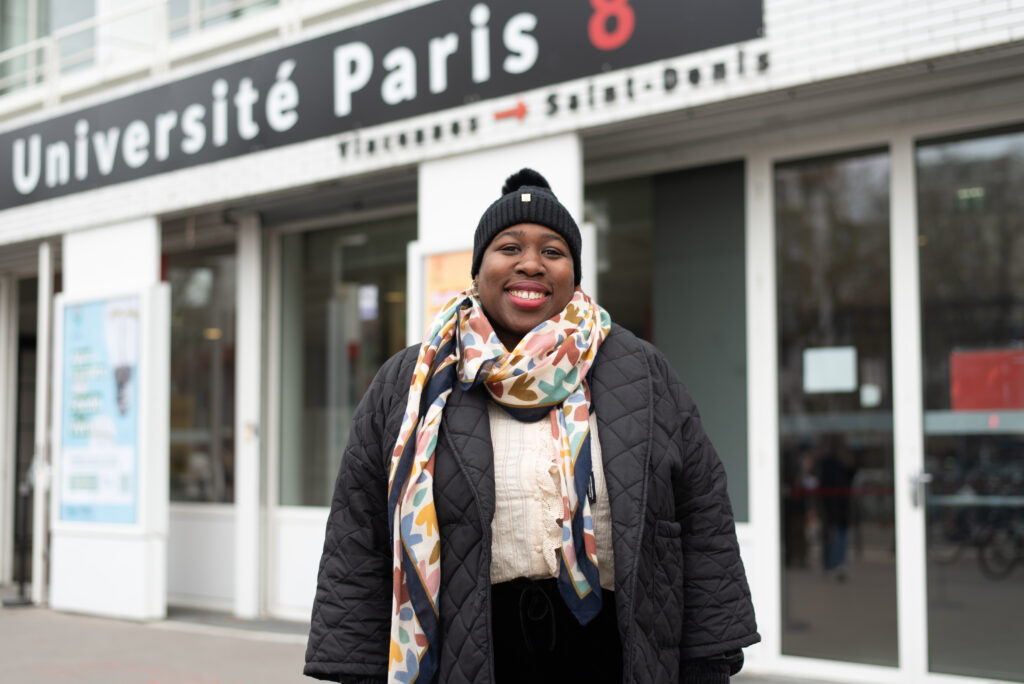
Aurélia NGG
The English version of this profile can be found at the end of the article.
Ce n’est pas Aurélia qui a eu l’idée d’apprendre la langue des signes française, c’est sa mère. « Ma mère adore chanter. Elle trouvait cette langue belle et voulait l’apprendre pour chanter en LSF. Mais comme elle travaillait à temps plein et elle n’avait pas le temps. » Alors elle délègue à sa fille, 17 ans, la mission d’apprendre… puis de lui transmettre.
Aurélia accepte. Elle se rend le samedi matin dans une association à Bordeaux, où elle vit. Et c’est une révélation. « Le professeur est sourd, le cours se fait en langue des signes. Je découvre un monde, je suis fascinée. » Elle venait pour sa mère, elle reste pour elle. Les effectifs fondent au fil des semaines : « On a commencé à 12, on a fini à 2. Mon prof m’a dit : “Tu es douée, on manque d’interprètes en France.” C’est là que la graine a été semée. »
La future interprète n’apprendra jamais vraiment à sa mère. « Manque de patience », sourit Aurélia. Mais sa mère n’oublie pas de lui rappeler, non sans humour : « C’est grâce à moi que tu as trouvé ton métier, tu me dois 10 % de tout ce que tu gagnes comme interprète. »
Pour autant, la jeune femme ne s’engage pas tout de suite sur la voie de l’interprétation. Après un bac scientifique, elle s’inscrit en physique avec l’idée de devenir contrôleuse aérienne. Découragée par le manque de concret de ces études, elle abandonne au bout de deux mois. Puis part un an en Irlande comme jeune fille au pair. Là-bas, elle rencontre des personnes sourdes. « J’avais juste une année de LSF derrière moi, mais la communication passait quand même. » Elle accroche. De retour en France, elle s’inscrit en linguistique à l’université. « Je me disais que je n’allais pas aimer… et en fait, j’ai adoré. »
Licence, puis master à Paris 8. À côté de ses études, elle travaille dans un institut pour jeunes sourds. Elle sort diplômée en 2012. « Ce n’était pas un projet de carrière. Mon but, c’était de maîtriser la langue. »
À ses débuts, elle partage son temps entre une activité d’interprète indépendante et une recherche doctorale sur la traduction en langue des signes, qu’elle abandonnera en 2016. Les premiers pas dans le métier sont chaotiques. « Je ne connaissais pas les codes, notamment sur les tarifs. Je pensais bien faire. On m’a reproché de casser le marché. J’ai compris, mais j’aurais aimé qu’on me l’explique autrement. »
Elle lance en 2014 un blog, La tête froide, pour raconter le quotidien du métier. Pourquoi ce titre ? « Parce que quand j’interprète, ma tête chauffe. Alors j’essaie de la garder froide. » Après un retour à Bordeaux, une nouvelle opportunité la mène aux Pays-Bas pour une thèse sur l’interprétation en langue des signes internationale (ou Signes Internationaux), financée à la Radboud University, qu’elle mène en parallèle de son activité d’interprète.
Du métier d’interprète, elle retient « le côté humain, surtout. » « On entre dans des situations très différentes, on rencontre des gens qu’on n’aurait jamais croisés. Ça ouvre l’esprit. » Elle se souvient d’un PDG, en coulisses, juste avant un discours : « Il gérait tout l’argent de la société, mais il stressait, comme moi. » Même tension, mêmes fragilités.
Parfois, l’actualité s’invite de façon plus brutale. « On interprète pour des familles ukrainiennes qui viennent d’arriver. La guerre, ce n’est plus seulement à la télé. Elle est là, dans les récits qu’on te fait en langue des signes. »
Ce métier, dit-elle, « a du sens ». Quand le message passe, quand les personnes remercient. « C’est rare, dans un travail, d’entendre merci. » Mais il y a un revers à la médaille : « Quand ça ne va pas, on ne peut pas se cacher et il faut aussi savoir recevoir la critique. »
En 2022, elle commence à enseigner à Paris 8. Face aux étudiants, elle reconnaît ses propres débuts. « Je me suis dit : il faut que quelqu’un transmette. » Elle crée alors une newsletter, Le 15-15, envoyée chaque 15 du mois à 15 heures, en référence aux rotations de 15 minutes que font les interprètes. Conseils pratiques, retours d’expérience, sujets parfois tabous : « des choses qui servent vraiment dans ton quotidien d’interprète. »
Deux newsletters en une, en fait : une de veille, gratuite, et une avec du contenu exclusif, payante. Aujourd’hui, plusieurs centaines d’interprètes la lisent.
Et depuis janvier 2025, il y a une déclinaison anglophone, The 20-20, qui compte environ 300 abonnés. Cette activité représente environ un jour et demi de travail par semaine. Les sujets qui ont été le plus lus l’année dernière : les discriminations et la TVA.
Dans le même esprit, elle crée aussi une bourse pour les étudiant·es. Pour en bénéficier, il faut proposer un projet pour améliorer le quotidien des interprètes.
Sa thèse terminée, elle est maintenant docteure en linguistique des langues des signes, spécialisée dans l’interprétation en langue des signes internationale, elle rentre à Bordeaux à la fin de l’année dernière, avec l’intention de se poser et de diminuer les trajets en train et en avion.
Dans la ville de son enfance, elle reconstruit peu à peu son réseau. Moins de volume qu’à Paris (où elle continue à travailler de temps en temps pour l’Agence i LSF ), mais un autre équilibre. « Je fais la balance avec la qualité de vie. » Elle privilégie l’interprétation de liaison : « C’est là qu’on voit directement si ça passe ou pas. C’est la vraie vie. » Par la force des choses, elle confie aussi être à l’aise dans le milieu universitaire et académique, sans oublier le milieu religieux chrétien et l’interprétation en langue des signes internationale.
On l’a compris : Aurélia fait partie de ces personnes passionnées par leur métier. Mais en dehors de ça, elle aime aussi danser : hip-hop, afro, zumba. Elle cite aussi la lecture et « se poser avec des gens et papoter ».
Elle livre un dernier souvenir avant d’aller retrouver ses étudiants à Paris 8 : un accompagnement à l’hôpital. Un patient sourd, sur le point de perdre la vue, se fait opérer. Elle l’accompagne jusqu’à l’endormissement, puis dans la salle de réveil. « Il était dans le noir, paniqué. Je lui ai pris la main, je lui ai signé que j’étais là. » Il ne lâchera pas sa main pendant de longues minutes.
Quelques mois plus tard, elle le recroise. Il la reconnaît à peine. « On avait vécu un moment très fort… et rien. Je me suis dit : il ne faut vraiment pas prendre les choses personnellement dans ce métier. »
Une manière, peut-être, de garder la tête froide.
English Version :
It wasn’t Aurélia who had the idea of learning French Sign Language (LSF), it was her mother. ‘My mum loves to sing. She was enamoured with the beauty of LSF and wanted to learn it so that she could sing in the language. But she was working full time and couldn’t fit it into her schedule’. So, Aurélia’s mum entrusted her daughter—just 17 at the time—with the task of learning LSF, in the hopes that she would pass on what she had learnt.
Aurélia agreed. She began visiting a local organisation every Saturday morning in Bordeaux, where she lived. And it’s a revelation. ‘The teacher was deaf, and the course was conducted in sign language. It was like diving into a whole new world, and I was captivated’. She went for her mother, but she stayed for herself. Attendance dwindled as the weeks went by: ‘There were 12 of us at the start of the course, but only 2 at the end. One day my teacher said: “You’re talented, and we need interpreters in France.” That’s when the seed was planted.’
The future interpreter never ended up teaching her mum the craft. ‘I wasn’t patient enough’, Aurélia says with a smile. But her mother never forgets to remind her, not without a touch of humour: ‘Thanks to me, you found your calling. I’d say you owe me 10% of everything you earn as an interpreter’.
Still, the young woman didn’t set her sights on becoming an interpreter straight away. After completing her A-levels in science, she began studying physics with the goal of becoming an air traffic controller. Discouraged by the lack of practical application in her studies, she dropped out after two months, then spent a year in Ireland as an au pair. There, she made some friends in the deaf community. ‘I only had a year of French Sign Language behind me, but we managed to communicate anyway’. She was smitten. Back in France, she enrolled in linguistics at university. ‘I didn’t think I would like it, but actually, I loved it’.
She completed a bachelor’s degree, then a master’s at Paris 8. Alongside her studies, she worked at an institute for deaf youth and graduated in 2012. ‘I didn’t see it as a career path. I just wanted to master the language’.
At first, she split her time between working as a freelance interpreter and doing doctoral research on sign language translation, which she decided to give up in 2016. Her first steps into the profession were chaotic. ‘I wasn’t aware of the unwritten rules, particularly when it came to rates. I thought I was doing the right thing but was accused of undercutting the market. I understood, but I would have liked to have had it explained to me differently’.
In 2014, she launched a blog, La tête froide (A cool head), to chronicle the day-to-day realities of the profession. What inspired the title? ‘Interpreting sets my hair on fire. I was always trying to keep a cool head’. After returning to Bordeaux, a new opportunity led her to the Netherlands to pursue a PhD in international sign language interpretation (or International Signs), funded by Radboud University, which she completed alongside her freelance interpretation work.
What she values most about being an interpreter is ‘the human aspect, above all. You find yourself in all sorts of situations and with all sorts of people you would have otherwise never met. It broadens your horizons’. She remembers a CEO, backstage, just before a speech: ‘He was a big shot, managing all the company’s money, but he was stressed. So was I, for that matter’. Same tension, same vulnerabilities.
Sometimes current events hit home much more intensely. ‘We interpret for Ukrainian families who have just arrived. The war is no longer just something you hear about on the telly. It’s right there, in the stories people tell you in sign language’.
This profession, she says, ‘has meaning’, when the message gets across, when people say thank you. ‘It’s rare to be thanked for your work’. But there’s a downside, too: ‘When things go wrong, you can’t hide it, and you have to be able to handle criticism’.
In 2022, Aurélia began teaching at Paris 8. She sees herself, and her humble beginnings, in her students. ‘I told myself: someone has to pass this on’. So, she started a newsletter, Le 15-15 (The 15-15), distributed on the 15th of every month at 3:00 p.m., in reference to the 15-minute shifts that interpreters work. With practical tips, insightful stories and the occasional taboo tale, the newsletter covers ‘things that actually serve an interpreter in their daily work’.
It’s two newsletters in one, in fact: one with free industry updates and a paid version that features exclusive content. Today, several hundred interpreters read it.
Since January 2025, there has been an English-language version, The 20-20, with nearly 300 subscribers. Writing the newsletter accounts for about a day and a half of work each week. The most popular subjects last year were discrimination and VAT.
She also set up a grant scheme for students. To qualify, applicants must propose a project aimed at improving the daily lives of interpreters.
Having completed her PhD, she is now a doctor of sign language linguistics, specialising in International Sign Language interpreting. She returned to Bordeaux at the end of last year, where she intends to settle down, hoping to cut back on all the train and air travel.
Back in her childhood home, she has gradually begun rebuilding her network. There’s not as much work as in Paris (where she still occasionally works for Agence i LSF), but there’s a different kind of balance. ‘I can now balance my work with the quality of life I desire.’ She prefers liaison interpreting: ‘You can see straight away whether or not it’s working. That’s real life’. By way of her experience, she also admits to feeling at home in university and academic settings, not to mention in the Christian community and interpreting in International Sign Language.
It’s clear that Aurélia is passionate about her work. But beyond that, she also loves dancing: hip-hop, Afro, and Zumba. She’s an avid reader and loves ‘sitting down with people for a chat’.
Before heading back to her students at Paris 8, she shares one last memory about accompanying a client to the hospital. A deaf patient, on the verge of losing his sight, was about to undergo surgery. She stayed with him until he fell asleep, then was back by his side when he woke up. ‘He was in the dark, panicking. I took his hand and signed to him that I was there’. He held her hand tightly for several long minutes.
A few months later, she bumped into him again. He hardly recognised her. ‘We had shared such a powerful moment together, but nothing. Just goes to show, you really can’t take anything personally in this profession’.
Perhaps it’s yet another way of keeping a cool head.
—
Translated by Cynthia Pecking
info@cynthiapecking.com