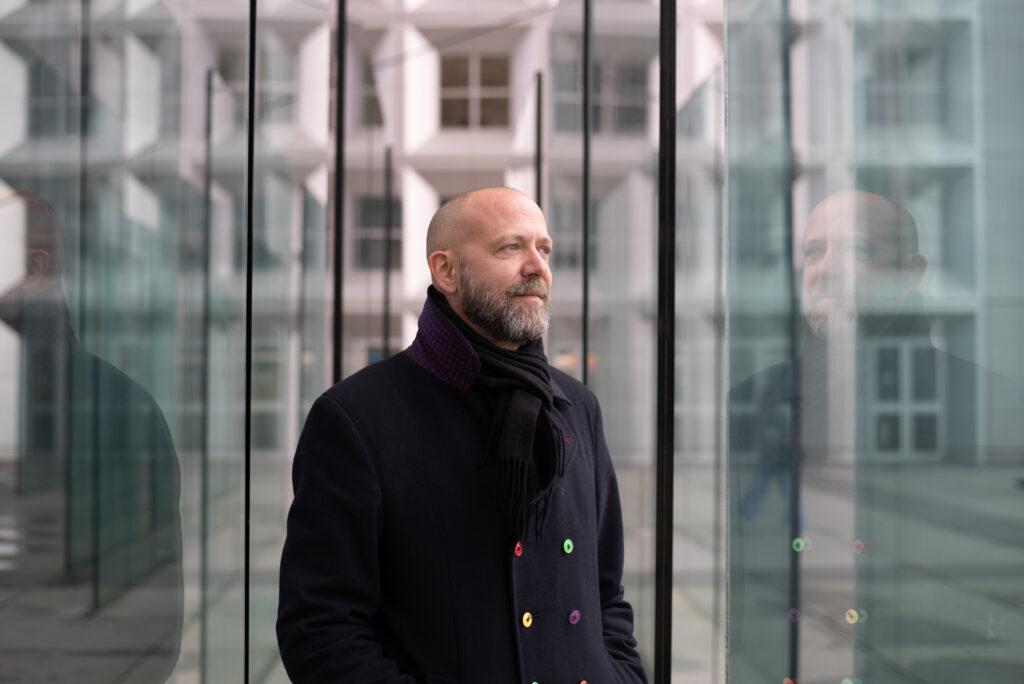
Jérome Bourgeois
The English version of this profile can be found at the end of the article.
D’habitude, Jérôme préfère se rendre au travail à vélo, mais cette fois-ci, il a pris le RER. La Défense n’est effectivement pas le lieu le plus adapté aux deux-roues. Attablé devant un café, il déroule le fil de sa vie et de son parcours professionnel qui l’ont amené à devenir interprète en langue des signes (LSF).
Il naît et grandit en banlieue parisienne. Ses parents, sourds, furent des acteurs du « Réveil Sourd » à Paris dans les années 70. Son père, Christian Bourgeois, a notamment co-fondé l’Académie de la langue des signes française et en fut le premier président. Jérôme baigne donc très jeune dans un environnement fortement militant, pour la reconnaissance et la valorisation de la culture sourde, de la langue des signes et de l’accès aux droits.
Comme beaucoup d’enfants CODA (Child of Deaf Adult – enfant entendant de parents sourds), il interprète dès son plus jeune âge, en particulier pour sa mère, née en ex-Yougoslavie, émigrée à l’âge de 18 ans : « J’ai été très rapidement confronté à des problématiques d’adultes : traduction de courriers administratifs, rendez-vous à la banque, chez le médecin, à la Sécurité sociale, à la CAF, à l’ANPE… Et aussi aux événements intrafamiliaux : baptêmes, mariages, enterrements. » Il traduit aussi souvent le journal télévisé. Cela confine parfois à l’absurde, ajoute-t-il, quand sa mère lui demande de traduire Rabbi Jacob, avec Louis de Funès, « un acteur très caricatural, gestuel, visuel, qui n’a pas besoin d’être traduit ».
Lorsque la question de son avenir se pose, sa mère a une idée bien précise : « Tu devrais être interprète, c’est évident. » Lui ne partage pas son avis : « Si être interprète, c’était traduire ce qui passe à la télé, traduire toutes les galères que les gens traversent — de ma famille, des amis, même de gens que je ne connais pas —, rentrer dans leur intimité, leurs problèmes humains… pour moi, c’était hors de question. C’était déjà suffisamment lourd à gérer en tant qu’enfant de personnes sourdes. »
Avait-il autre chose en tête ? « Oui, être heureux. Je savais déjà, sans savoir quel métier je voulais faire, que le travail ne devait pas être une contrainte de la vie. Et cette dimension-là, je la trouvais pénible. »
Il s’intéresse alors à la photo, dans les pas de son père, souvent appareil en bandoulière lors de ses déplacements militants dans le monde entier. Celui-ci l’encourage, tout en le prévenant : les pellicules, ça coûte cher. Jérôme se forme en autodidacte et pratique en amateur… pour l’instant.
Pour ses études, il se lance dans un cursus de sociologie. Et se « fâche avec Bourdieu ». À travers ses livres. « Je n’étais pas du tout d’accord avec le déterminisme social. J’en veux pour preuve que j’accédais aux études supérieures alors que mes parents étaient diplômés d’un CAP. »
Il valide son DEUG sans grande conviction, puis bifurque vers des études courtes en communication d’entreprise. Il travaille ensuite en régie publicitaire pour TF1, puis pour l’agence de pub TBWA\Corporate. Lassé de cet environnement et du rythme de vie qui va avec, il se lance dans la photo professionnelle.
Un ami, cofondateur du fanzine L’ABCDR du son, consacré au rap et aux cultures urbaines, lui propose de l’accompagner pour illustrer les articles. « C’est comme ça que j’ai rencontré plein de figures du rap français et international, et que j’ai pu constituer mon portfolio pour me sentir plus légitime en tant que portraitiste et photographe d’événements », raconte Jérôme. Cela lui ouvre les portes des agences d’événementiel et de projets, dans le monde corporate comme dans celui de l’art contemporain. Il sera même publié dans plusieurs ouvrages de référence, mais sans formation académique ni mentor, il finit par se sentir « limité dans [ses] capacités, dans [ses] envies de [se] développer ». Il a alors 30 ans.
C’est à ce moment-là qu’un contact lui propose de réfléchir à la stratégie de communication d’une petite association de personnes sourdes, l’ARIS. En travaillant sur le sujet, il a l’opportunité d’apercevoir le travail des interprètes de l’association. Cela pique sa curiosité : « Je me rends compte que ce n’est pas du tout ce que je faisais, moi, interprète de famille. Il y avait vraiment une posture professionnelle, une distance avec les personnes concernées qui était naturelle et qui permettait aussi une plus grande liberté de mouvement et de gestion de la situation de la part de l’interprète. »
Il demande comment devenir interprète. « On me répond : ce n’est pas compliqué, il faut juste que tu aies un master d’interprète. » À l’époque, à Paris, deux options : SERAC à Paris-8 ou l’ESIT à Paris 3.
À SERAC, il y a les amis de son père. « C’est là que Bourdieu revient dans la boucle : j’ai pris conscience que j’avais ce patrimoine culturel qui me permettait d’accéder à ce métier-là assez facilement, puisque j’avais la langue, la culture, j’avais le réseau et le nom de mon père. » Il préfère éviter la dimension émotionnelle et, par extension, familiale, et choisit l’ESIT. Après avoir validé une VAE, il entre directement en M2 et sort diplômé en 2012.
Il commence à travailler en tant qu’interprète à l’ARIS. Il la quitte en 2015 et rejoint un institut sous la tutelle du ministère de l’Enseignement supérieur et de la Recherche. En parallèle, il exerce en indépendant, notamment à la la télévision où il interprète des journaux télévisés et collabore régulièrement avec l’Agence i LSF depuis deux ans.
Il travaille également de et vers l’anglais (3e langue) et vient de valider une certification à l’interprétariat en signes internationaux : « Pouvoir travailler sur ces combinaisons linguistiques, ça m’intéresse beaucoup. »
Lui qui ne voulait pas d’un métier pénible trouve finalement son compte dans l’interprétariat : « Tous les jours, c’est différent. Aujourd’hui à La Défense, demain ailleurs, d’un plateau télé à une réunion dans la même journée. C’est cette diversité, cette richesse qu’offre ce métier que j’ai trouvée et que j’aime. »
Parmi ses souvenirs marquants, il y a la scène principale de Solidays. Pour la première fois, il se trouve face à 50 000 personnes pour interpréter l’hommage aux bénévoles : « C’est électrisant, je comprends les artistes qui sont galvanisés par l’énergie de leur public. »
Jérome se souvient aussi d’avoir interprété pour i LSF le discours de campagne d’Emmanuel Macron en 2017 : « Parce que c’est notre projet ! » . « Il est complètement habité. J’incarne le discours et je suis aussi exalté que lui, mais en langue des signes, donc c’est très visuel. C’est devenu un mème sur Internet, qui a fait des millions de vues avec une musique un peu disco-funk. Il y a un montage où je suis avec des spotlights, une musique un peu entraînante et le commentaire “wow l’interprète, il est chaud !”. »
En dehors du travail, ce père de deux enfants pratique l’escalade avec son aîné de 12 ans. Sa belle-famille vivant en Bretagne, il s’y rend souvent et se jette à l’eau, quelle que soit la saison, pour se baigner ou surfer.
La photo reste enfin une passion, même s’il a moins de temps pour s’y consacrer. Un projet démarré en 2012 lui tient particulièrement à cœur : « Après, Après ». Inspiré de cette phrase souvent adressée aux personnes sourdes — « je t’expliquerai après » —, le projet confronte deux portraits d’une même personne : l’un montrant la réaction immédiate, l’autre ce que la personne a réellement ressenti.
Une autre manière de traduire, finalement, mais cette fois-ci via l’art.
Bonus : découvre le nom-signe de Jérome Bourgeois
English Version :
Jérome usually prefers to ride his bike to work, but this time he took public transport. La Défense isn’t exactly the most bike-friendly area. Sitting at a table with a cup of coffee, he recounts his life story and professional journey, one that led him to become a French Sign Language (LSF) interpreter.
He was born and raised in the Parisian suburbs, and his parents, who are deaf, were active in the ‘Réveil Sourd’ movement in Paris in the 1970s. His father, Christian Bourgeois, co-founded the French Sign Language Academy and served as its first president. This meant that Jérôme was immersed from a very young age in an environment of activists committed to recognising and promoting Deaf culture, sign language and access to rights.
Like many CODA (Child of Deaf Adults) children, he began interpreting at a very young age, particularly for his mother, who was born in the former Yugoslavia and emigrated at the age of 18: ‘I was confronted with adult issues very early on: translating administrative letters, interpreting at the bank, the doctor’s office, the Social Security and Family Allowance office, the National Employment Agency… and then there were family events: baptisms, weddings, funerals.’ Jérome also often interprets the evening news. But sometimes it borders on the absurd, he adds, when his mother asks him to interpret *Rabbi Jacob*, starring Louis de Funès, ‘a very caricatured, gestural, visual actor who needs no interpretation at all’.
When the question of his future would come up, his mother always had a very clear picture: ‘You should be an interpreter. It’s obvious.’ But he didn’t share her opinion: ‘If being an interpreter meant interpreting what’s on TV, constantly confronting the hardships people go through—my family, friends, even people I don’t know—delving into their private lives, their personal struggles, for me, that was out of the question. It’s already hard enough dealing with that as the child of deaf parents’.
Did he have anything else in mind? ‘Yes, to be happy. I already knew—even without knowing what career path I wanted to pursue—that work shouldn’t be a burden on my life. And this interpreting stuff… I found it painful’.
He then developed an interest in photography, following in his father’s footsteps, who often had a camera slung over his shoulder during his activist trips around the world. His father encouraged him but gave him a warning too: film is expensive. Jérôme taught himself and practiced as an amateur… at least for the time being.
As for his studies, he enrolled in a sociology programme and had a ‘falling out with Bourdieu’—through his books. ‘I didn’t agree at all with social determinism. The proof is that I was able to pursue higher education even though my parents only had a Certificate of Professional Competence’.
He completed his undergraduate degree without much enthusiasm, then switched to a short programme in corporate communications. He went on to work in advertising sales for TF1, then for the advertising agency TBWA\Corporate. After growing tired in that environment and the fast-paced lifestyle that came with it, he launched a career in professional photography.
A friend, and co-founder of the fanzine *L’ABCDR du son*, dedicated to rap and urban culture, asked him to join the team and illustrate the articles. ‘That’s how I met lots of people in the French and international rap scenes and was able to build my portfolio so I could feel more confident as a portrait and event photographer,’ Jérôme explains. This opened doors for him at event and project agencies, in both the corporate world and the contemporary art scene. He was even featured in several reference books, but without formal training or a mentor, he eventually felt ‘limited in [his] abilities and in [his] desire to grow’. He was 30 years old.
That’s when an acquaintance suggested he consider developing a communication strategy for a small association for the deaf called ARIS. While working on the project, he had the opportunity to observe the work of the association’s interpreters. This piqued his curiosity: ‘I realized that it was nothing at all like what I was doing as my family’s interpreter. This was a truly professional endeavour, and there was a natural distance from the people involved that also allowed the interpreter greater freedom of movement and control over the situation’.
He asked how to become an interpreter. ‘They told me: “It’s not complicated; you just need a master’s degree in interpreting”’. At the time, in Paris, there were two options: SERAC at Paris-8 or ESIT at Paris 3.
At SERAC, he ran into some of this father’s friends. ‘That’s where Bourdieu comes back into the picture: I realized I had this cultural heritage that allowed me to enter the profession pretty easily, since I had the language, the culture, the network, and the influence of my father’s name’. He preferred to avoid the emotional—and, by extension, familial—aspect, so he chose ESIT. After completing a credit transfer programme, he entered the master’s programme directly and graduated in 2012.
Jérome began work as an interpreter at ARIS but left in 2015 to join an institute under the Ministry of Higher Education and Research. He also works as a freelancer, particularly in television, where he interprets newscasts and has been collaborating regularly with Agence i LSF for the past two years.
In addition, he works to and from English (his third language) and has just earned a certification in international sign language interpreting: ‘I’m really interested in working with these language combinations’.
He didn’t want a demanding job, and ultimately, has found his calling in interpreting: ‘Every day is different. Today I’m in La Défense, tomorrow I’ll be somewhere else—from a TV set to a boardroom all in the same day. It’s this diversity, this richness that the profession offers, that I have come to love’.
One of his most memorable moments was during an assignment on the main stage at Solidays. For the first time, he found himself in front of 50,000 people, interpreting the tribute to the volunteers: ‘It’s electrifying. I understand why artists are mesmerised by the energy of their audience’.
Jérôme also recalls interpreting Emmanuel Macron’s 2017 campaign speech for i LSF: ‘Parce que c’est notre projet !’ (Because this is our project!) ‘He’s wrapped up in the moment. I embody the speech and get just as fired up as he does, but in sign language, so it’s very visual. It became an internet meme that racked up millions of views, set to a bit of disco-funk music. There’s a clip where I’m shown with spotlights, some upbeat music, and the caption ‘wow, the interpreter is on fire!”’
When he’s not working, this father of two loves to go rock climbing with his 12-year-old son. Since his in-laws live in Brittany, he visits them often and braves the waters — to surf or swim — no matter the season.
Photography is still a passion of his, even though he has less time to devote to it. A project he started in 2012 is particularly close to his heart: ‘Après, Après’. Inspired by the phrase often directed at deaf people — ‘I’ll explain it to you later’— the project juxtaposes two portraits of the same person: one showing their immediate reaction, the other what the person actually felt.
Ultimately, it’s another way of communicating, but this time through art.
—
Translated by Cynthia Pecking
info@cynthiapecking.com